

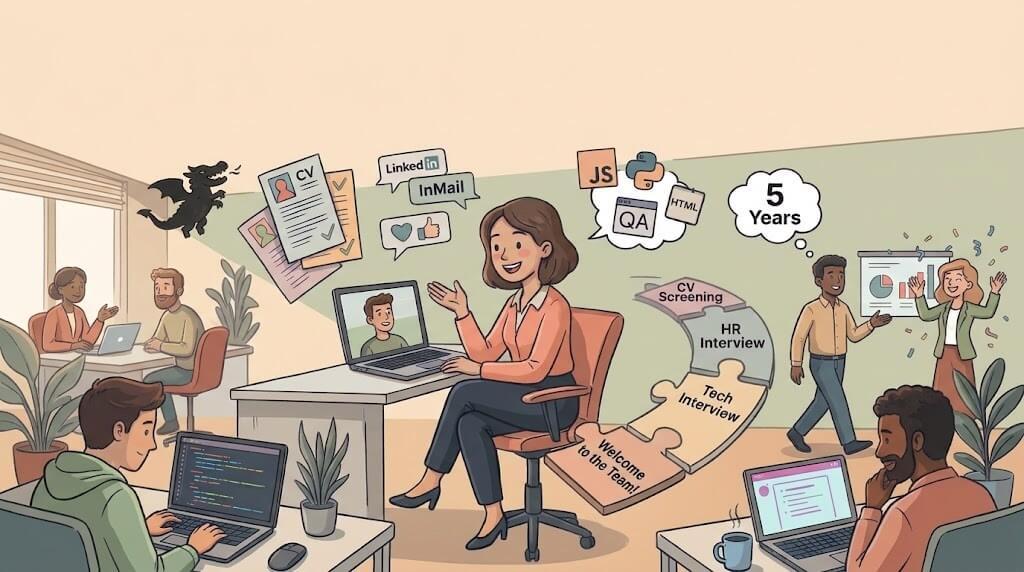
If you have ever received an email that reads: “Thank you for your interest in our vacancy. Your experience is valuable to us, but after detailed consideration, unfortunately, your candidacy will not be moving forward to the next stage,” then you are in the right place.
I happen to be the "monster" behind that text—the HR professional managing the recruitment process. We have all been in a situation where we felt an interview, a test, or the selection process as a whole went great, and we were almost certain we’d get chosen. Receiving a rejection after building up that expectation hurts much more and brings a far bigger disappointment than it would otherwise.
It might be hard to believe, but the interviewer may have genuinely liked you and still had to say no due to various reasons you might not have even thought of. Let’s take a deeper look into this process from the other side of the table, and I’ll try to give you some practical, helpful tips along the way.
Navigating the Process: CVs, InMails, and the LinkedIn "Ghosting"
In the tech sector—just like in most industries—selection consists of several stages, with specific criteria playing a role at every step. Let’s start with the simplest one: sending your CV and its subsequent review.
In this field, it’s quite common for recruiters to reach out directly via social media, mostly through LinkedIn. If you don't believe me, check your LinkedIn inbox—you might actually find a message from me there. (Getting left on "Read" here hurts more than in personal life, by the way!)
If you belong to the job seekers who sent their CV directly—thank you for that! Here are a few essential tips on what your CV should look like:
- Keep it concise and easy to understand: This is probably the universal description that fits a CV sent for almost any position, unless specified otherwise.
- Highlight key tech stacks: Make sure your CV clearly displays the primary tech stack required by the job posting that you actually have experience with.
- Tailor it to the vacancy: If there are specific requirements in the job description, definitely mention them in your CV. Avoid sending a generic, standard resume every time. Adapt it so that the relevant skills and experience you want the recruiter to notice catch their eye immediately. (This doesn't mean including false information, but rather bringing your most relevant strengths to the forefront!)
Don't worry, every single CV gets reviewed and nothing stays unread. A properly filled-out CV simply saves the recruiter time, makes it easier to see how relevant the candidate is, and leaves a good first impression.
"I send my CV, but they don't even respond..."
Does this phrase sound familiar? Unsurprisingly, I’ve been in that position myself. But let's go easy on recruiters here too—processes differ across companies. If your CV didn't pass the initial screening stage, you might not get a response right away. However, I promise that once our first communication begins, no matter at what stage your selection process ends, you will definitely receive a response.
Sending a CV is always worth it. There are situations where a CV sent for one vacancy was later used for another position and new opportunities, or served us for future collaboration. Since hiring is a drawn-out process, candidates we’ve already interacted with and who have completed part of the process are worth their weight in gold to recruiters.
(If you don't believe it, feel free to submit your CV—and when you least expect it, we’ll contact you! 😉)
A Real Opportunity: The Candidate Talent Pool
If you’ve sent your CV and taken part in the selection process, but didn’t end up starting a role with us at this stage, we have an even more tangible opportunity for you.
Along with our internal team profiles, Omedia gives all potential candidates the opportunity to join our dedicated candidate database (containing key profile information similar to a CV). Candidates in this database truly carry extra gold value for us!
Having a profile in our database and letting us search for candidates internally opens up a much shorter path for future vacancies at Omedia, as our search usually begins with existing candidate profiles (which also means fewer "left on read" moments on LinkedIn in an HR's life!). Of course, we offer this opportunity to everyone who participates in our recruitment process. But let's talk about this topic in even more detail next time!
"Where Do You See Yourself in 5 Years?" — How to Prepare for the HR Interview
Congratulations, you successfully passed the CV screening, and the next stage is the HR interview!
Now, this is definitely not an ordinary HR interview. You should expect questions you’ve never heard in any other interview before—and definitely not the clichéd question mentioned in the headline above! Don't worry—while these questions might seem unusual, they can be very pleasant and interesting for you. You might even get to share something you've always wanted to share with a future employer.
An interview isn't just an "interrogation" of the candidate by the HR; it is a two-way process. So definitely ask questions about topics that interest you!
What matters most in an HR interview?
The very first piece of advice I can give you is sincerity. You don't necessarily have to tell me how you made your previous employer lose $2 million (good luck keeping a secret in Georgia, that kind of rumor would've beaten you to this interview!) but answer every question honestly. No matter how "correct" a candidate's answers might sound, an interviewer will always tell if they aren't being genuine.
Look at the HR interview as a meeting where both sides can get answers to the topics they care about. Also, please make sure to keep your camera on throughout the interview. This isn’t just a formality—it builds trust and creates a much more authentic connection, which is especially important in today's remote world.
What criteria are evaluated?
The criteria depend heavily on the position—whether it's a Developer, Project Manager, QA Specialist, or another role. Of course, their interviews may differ, but they also share common criteria that every team player needs, such as teamwork, communication, and Cultural Fit.
We evaluate communication ethics, how you position yourself in a team, how effectively you deliver information to the right person, and how strong of a team player you are. The interview is a great chance for you to talk about real examples from your past experience.
Mutual Interest and Alignment
One of the main things an interviewer observes during the meeting is whether the interests and expectations of both sides match. Having a mutual understanding between the company and the candidate is critically important.
A candidate might be a great soft-skills match for our company culture, but there might not be a complete alignment with the immediate needs of the specific vacancy. Since this is the tech sector, very specific technical knowledge and experience are sometimes required, or there might be administrative details we cannot agree on at that moment.
Recruiters also look at how suitable this vacancy and Omedia will be for you, and whether the project will keep you genuinely engaged. There will be questions about the infamous "motivation," but setting banalities aside, whether a candidate is genuinely motivated to work in a specific position is crucial. Recruiters look at how engaging the project will be for you because employee satisfaction is a top priority for the company.
Sometimes a candidate has different goals and expectations, wants to work on a different type of project, or in a different role. In those cases, the company simply cannot offer what they want at the moment. Therefore, the reason a collaboration doesn't happen is sometimes just that the company cannot meet your current expectations.
How do you pass the Cultural Fit check?
Teamwork and communication are clear enough, but how can you ensure you satisfy the Cultural Fit part? This is something the interviewer forms an impression of based on all the questions combined.
These values might not be written down in an official handbook, but they represent the company's internal culture—such as personal relationships, communication styles, work ethics, and attitudes toward colleagues. The interviewer gets an overall impression of this throughout the whole conversation, so you won't need to prepare a rehearsed answer to "What values do you appreciate in a company?" in advance.
Being open and honest during this process is just as important for you. If there isn't a mutual fit, you won't feel comfortable in the long run either, which can lead to unnecessary misunderstandings later on.
Remember: It's a Two-Way Selection
We cannot avoid the fact that I will have more questions for you (though sometimes it's the other way around!), but you aren't just being evaluated by the HR. Selection and cooperation are mutual. Beyond technical questions, asking about what interests you often reveals fascinating details about you as a candidate.
Will There Be Live Coding? — The Tech Interview Series
If you successfully passed the HR interview and impressed the recruiter with your soft skills, the next stage is evaluating your technical and professional knowledge. This is usually a skills interview—a check of your professional knowledge and/or an interview directly with a representative of the department you’ll be working with.
Let’s assume you are a developer (congratulations, you chose a great profession!), and you are going through the developer selection process. This is where Omedia’s "golden employees" come in—the experienced team members Omedia trusts to evaluate a candidate’s technical knowledge. I have to admit, they are just as important as HR (not easy for an HR to admit!), and they are highly experienced not only in development itself, but also in evaluating knowledge—which requires a whole different set of skills.
Tips for the Technical Interview
Knowledge is usually tested in two main directions:
- General domain knowledge: Testing knowledge corresponding to your field and seniority level (e.g., if you are a Java Developer).
- Specific technology requirements: If the role has specific requirements for deeper knowledge in a particular technology, expect detailed questions about it. Beyond theoretical and practical knowledge, it’s essential to understand the project requirements and align with them.
In addition, there are a few competencies in the tech sector that make a candidate exceptionally valuable. Sometimes, knowing a specific answer off the top of your head isn't as critical as having the ability to research and find information when needed. Learning new skills on the fly is immensely useful—just like many professionals from non-tech fields learned development themselves when they saw the need.
In the tech industry—especially in the age of AI and constant technological shifts—a developer simply cannot survive without adaptability.
Also, don't be afraid to admit during an interview if you don't know a specific topic. It might not be critically important for the role, and we deeply value honesty and transparency. If it is a critical topic for the position, then it becomes clear to both sides. The company won't create wrong expectations, avoiding a scenario where work stalls down the line. (Though our selection process is designed to prevent that exact situation!). Project requirements and technical knowledge are essential, but these learning and research skills are no less important—so keep that in mind when applying!
Do I Have to Go Through Another Interview? (Outstaffing & Client Interviews)
Let's touch on this briefly: if you are a developer going through the selection process for an outstaffing project, your final interview will be with the client.
This feels a lot like sending a child you’ve tutored and raised off to national exams! During this interview, almost all the skills and knowledge you demonstrated throughout the recruitment process will be put to the test.
Client interviews naturally vary depending on the project and the managers involved. It’s a synthesis of everything you’ve passed so far—from the intro meeting and tech evaluation to logical, behavioral, or scenario-based questions designed to test specific abilities. Just like us, their primary goal is to find the right candidate to join their team and work on their project.
The experience gained from previous stages will serve you well here, giving you a fresh opportunity to showcase your skills. Plus, before making your final decision, you get to meet the team you’ll potentially be working with and ask all the questions you need.
"Hello! You Have Successfully Passed All Stages and Are Joining Omedia!"
When you receive this text (and a phone call, of course!), it means you defeated the dragon and made it to the final line—I never doubted you!
You’ll be joining the Omedia team, where a new, exciting, friendly, supportive, and hopefully successful world of opportunities will open up for you. The selection process might have been a bit tiring, but let's face it—hiring is like that across all industries. To unwind, Omedia also has plenty of fun and entertaining team activities, which you can read all about in our other blog posts! [Explore Omedia Blogs here]
And finally, to all the candidates who went through any stage of our process: time was invested on both sides. Since we operate in the same industry, we created our candidate database to make future collaborations seamless. (More on that in our next blog post!)
See? HRs don't just run recruitment—we write blogs too! 😉