

Previously on the Omedia HR Blog...
If you read our previous post, Error 404: Team Spirit Not Found — How to Design Informal Activities for Tech Teams, you already know how we browse through raw ideas, dodge the corporate survey traps, and frame the perfect questionnaire for a tech team. But once the voting poll closes and the roadmap is set, the real storm hits. Welcome to the implementation phase.
How do we actually turn these grand plans into reality? While the general cycle of executing a corporate event looks a lot like any standard implementation process, doing it in a tech company with Gen Z and Millennials comes with its own unique "bugs."
Before we look at our own Lessons Learned, let's quickly layout the classic, textbook steps of any event management framework:
- Roles and Responsibilities: Who is doing what?
- Procurement & Vendors: Booking, negotiating, and double-checking invoices.
- Internal Communication: Spreading the word and building excitement.
- On-Site Execution: Managing the live process and handling emergencies.
- Post-Mortem & Feedback Loop: Reviewing what went well and what crashed.
Now, let's look at how these steps actually play out in the wild.
In the organizational phase (and honestly, during the process itself), given our specific company dynamic and experience, flexibility is the absolute ultimate virtue.
1. Picking the Date: Don't Compete with the World
When scheduling, you aren't just looking at the days of the week. You must look at the global horizon.
- The Check: Is there a major festival, a highly anticipated concert, or a massive football match happening? Do not force your employees to make that painful choice—you will lose.
- The Workload: Informally check if a specific department is going through a brutal sprint or a heavy release period. Also, look out for weeks with public holidays—employees love to stack vacation days around them to travel, meaning your attendance numbers will plummet.
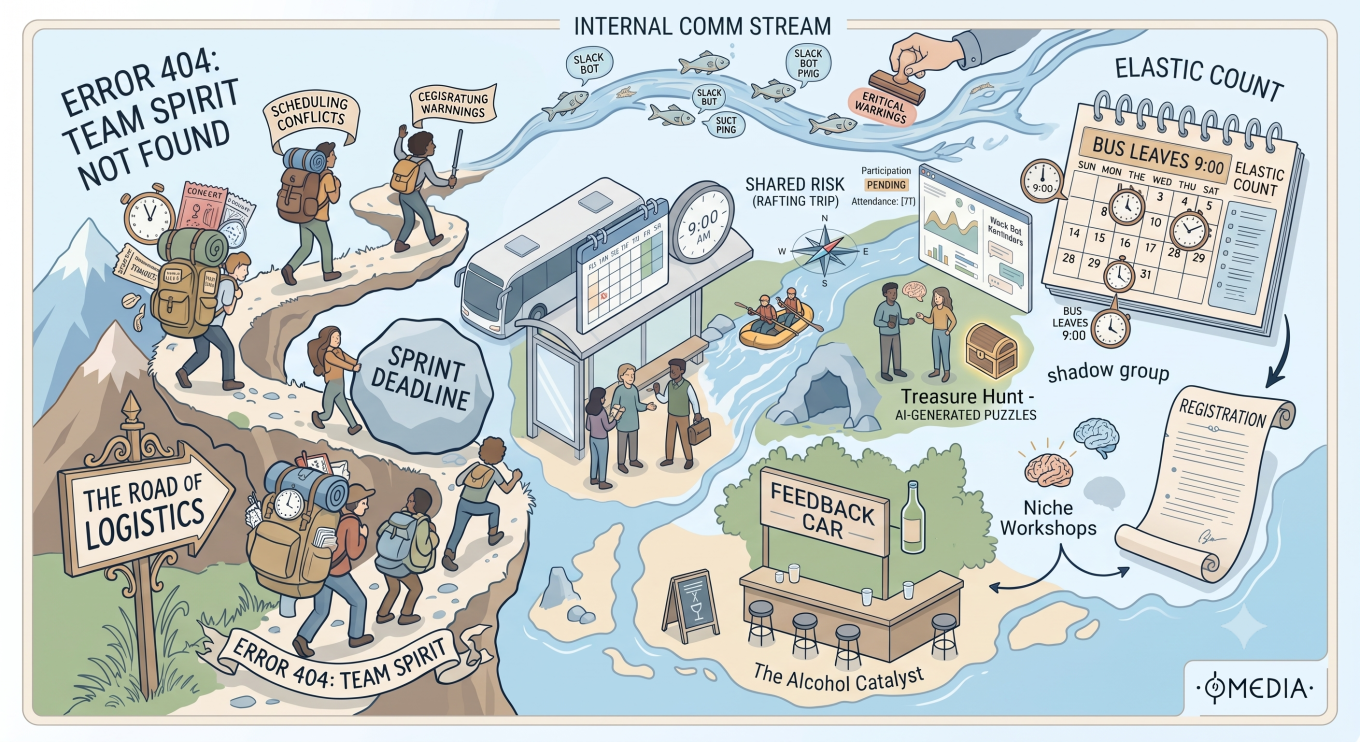
2. The Attendance Paradox: Mastering the "Elastic Count"
Based on our experience, it is practically impossible to know exactly how many employees will show up. That’s why we are always prepared for multiple scenarios.
Sure, we have official registration forms, and we ping the team at least 3 times to fill them out. But we also maintain a shadow, "informal list" of people who we know want to come but somehow haven't appeared on the spreadsheet yet.
We’ve had times where the day before an event, we suddenly discover people who fully planned on coming but "just forgot to register." Or conversely, someone who RSVPed Yes suddenly wakes up in a different mood, decides to stay home, and completely forgets to notify us. This is where you and your "saved venting buddy" need to be emotionally prepared.
🚨 Pro-Tip: If an activity requires strict headcounts, be ready for individual pings (Slack bots are a lifesaver here). When making public announcements, switch from gentle reminders (Warnings) to hard system blockers (Critical Errors).
Use phrasing like: "If you did not receive a confirmation message/email/info regarding this event, you do NOT exist in the system. Message me immediately."
3. Logistical Communication: Tech Teams Need "Error Warnings"
When sending out logistics info (e.g., transportation details, departure times, and locations), immediately follow it up with a "fail-safe" protocol.
With older generations, you didn't need to specify what happens if you are late. But practice shows that with tech folks and Gen Z, you need absolute clarity. If the bus leaves at 9:00 AM, write: "The bus leaves at 9:00. At 9:01, you are looking at a moving target."
Also, before booking a massive bus, double-check who is driving their own car. To a tech team, "We are all riding the bus together" does not automatically translate to "I should get on the bus." Always add a clear trigger: "If you plan to drive yourself, you must message me or toggle this checkbox by [Date/Time]."
Because of this chaotic movement, tracking metrics, managing procurement, and placing orders is a wild ride.
📈 The HR Buffer Rule: Always calculate your resources (food, drinks, spaces) for +- 10 to 15 people from your official count, and always have a Plan B ready in case a massive wave of people decides to show up at the very last second.
4. Leaving Space for Innovation: The Unhyped Hits
When finalized, your annual plan should always leave a little bit of breathing room (and a little bit of cash) for spontaneous employee initiatives. If a team member suggests an activity, it’s great to bring it to life—even if they might change their mind about attending at the last minute!
Even if they ghost it, you still got a great new activity out of it, and you can always go back to your saved favorite colleague to blow off some steam.
The second area we always leave a buffer for is "The Unknown Activity." Often, employees are afraid of ideas they’ve never tried before. They don't know what to expect and assume it won’t be fun. Leave room to surprise them.
🧠 Niche Workshops
In the tech world, informal learning usually means "Tech Talks" or online courses—which are basically just lectures. Interactive workshops are an entirely foreign concept to them and are rarely associated with "having a good time."
If you want to develop this direction, introduce it smoothly. For us, this was a Mental Health Workshop that fit beautifully into our "Work Hard, Chill Harder" theme. It gave the team an avenue for self-reflection (which our team members genuinely enjoy) wrapped in an interactive format, opening doors for more complex initiatives down the road.
🌊 The Power of Shared Risk
After endless loops of "Eh, we are too lazy for outdoor activities, let's just go drink together," our highest engagement actually came from a group rafting trip.
A quick note for HRs: slightly extreme outdoor sports are incredible for team bonding. By nature, they force people to depend on and support each other in real-time. If your team shows even a spark of interest in this, run with it.
🧩 Gamification on a Budget
If you are reading this and panicking because your budget is non-existent, or you work at a company where management doesn't see the ROI of informal events—do not lose heart. Plenty of ideas work phenomenally with minimal costs.
While we are lucky with our management, we still love testing low-budget, high-creativity ideas. For example, we designed and organized an office "Treasure Hunt" entirely from scratch, hiding clues and the final treasure right inside our building. Back then, it took a massive amount of our time to plan. Today, doing a similar game using AI to generate clues and riddles makes the process ten times easier.
You can easily leverage your office space for Board Game Nights, Trivia Games, or Potluck Lunches. The key is creativity. Don't be discouraged if the initial turnout isn't what you dreamed of. Test, iterate, and observe.
5. On-Site Live Management: Don't Force the Fun
Our job doesn't end when the logistics checklist is ticked off. During the live event, you are dealing with a chaotic, unpredictable environment that demands massive emotional intelligence and flexibility.
- Connect the Dots: Actively connect people. Look for common ground—shared projects, mutual clients, or overlapping interests.
- The Micro-Climate Watch: At most events, people naturally divide into tiny micro-groups. Walk around these circles, make sure everyone is doing well, and mentally note the social dynamics.
- Rescue the Outsiders: Keep a sharp eye out for the "outsiders"—those who haven't found their group yet. Approach them, have a chat, and casually guide them toward an activity or a group of people they’ll actually vibe with.
- Have Fun Yourself: Seriously, you need to unwind too. Plus, if the facilitator looks miserable, it’s impossible to convince anyone else to have a good time.
6. The Post-Mortem & The Alcohol Catalyst
Gathering feedback for your next roadmap starts while the event is still alive. Ask people right then and there what they love and what is frustrating them. Pitch new ideas for the future while the emotions are high.
🍹 An Honest Insight: If your event involves a bit of alcohol, it acts as a miraculous creativity catalyst. Some of the absolute best, most innovative corporate ideas are born over casual drinks when guards are down.
Once the event ends, don't forget your standard, formal feedback forms. Sit down with your organizing team and analyze the raw data:
- What went right? What crashed?
- Which food or drink vanished first?
- What is something the employees wished they knew before coming?
Blow off some steam, laugh about the chaos, and get ready for the next sprint. Because ahead of you lies a whole new wave of beautiful chaos, unexpected surprises, and team buildings.
So, dear team... are you going to fill out that next survey now? 😉