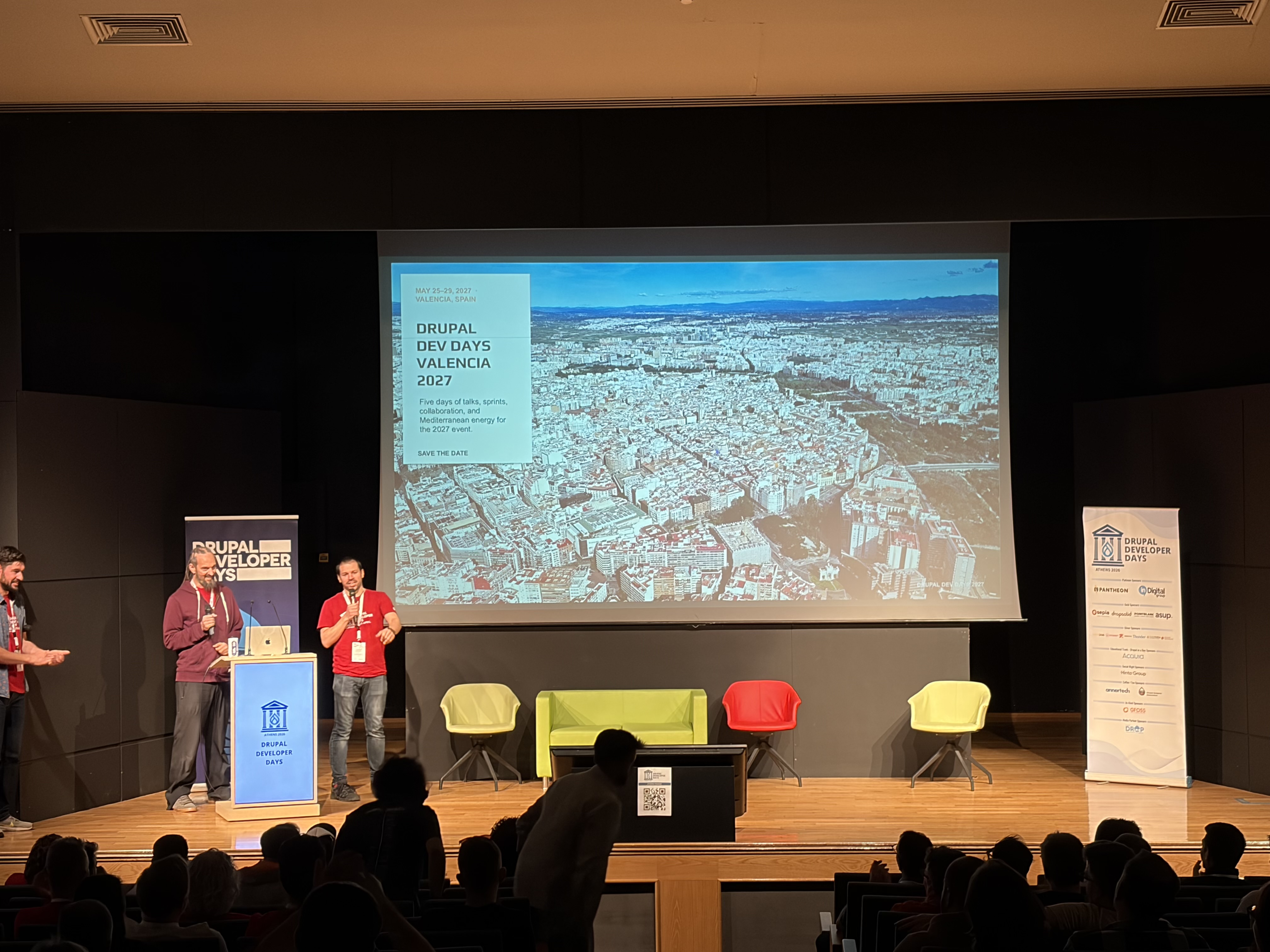
Last week Giorgi Gagoshidze and I packed our bags and flew to Athens for Drupal Developer Days. The weather turned out nicer than I had expected and since we were on the ground for five days, the trip ended up feeling a little like a short holiday squeezed in between everyday work.
Why I keep coming back to DDD
I always prefer Drupal Dev Days over the bigger conferences. Every year I try to make it to FOSDEM in Brussels for the same reason: it stays close to the foundations, it's nerdy in a good way, and the people in the room are there for engineering, not for the booth swag. DDD takes that one step further for me. It's smaller and more familiar, closer to a reunion than a conference. You bump into people you're working with online and finally every year, get to share a coffee, a beer, or an argument about AI slop :))
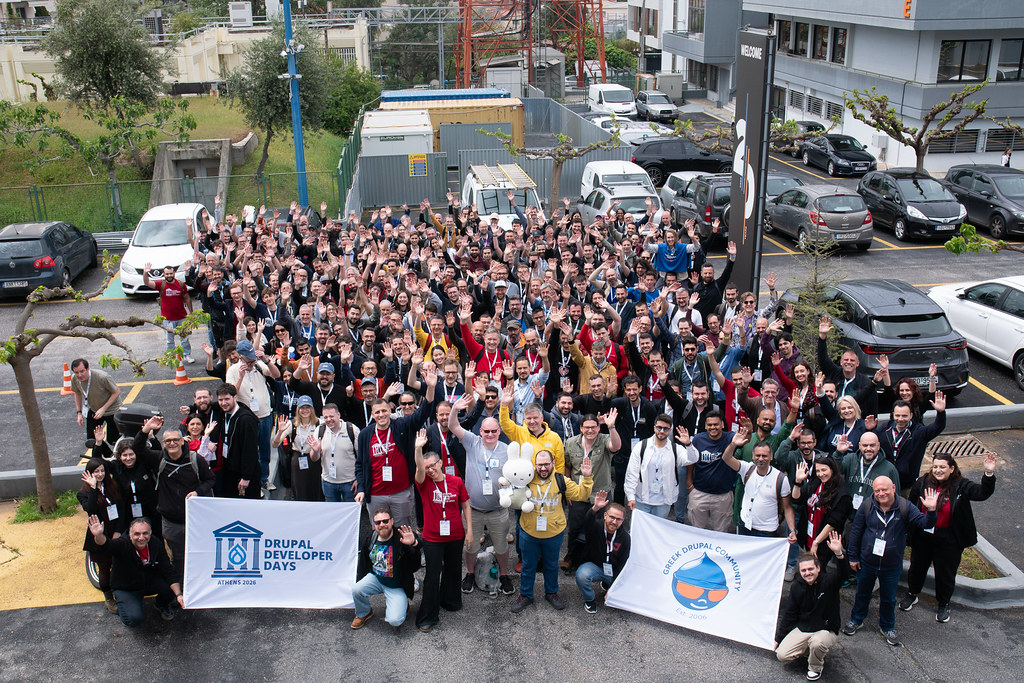
This year was no exception. The Greek community pulled off a fantastic event, and Athens turned out to be a very fitting backdrop for a week of conversations about what's next for Drupal.
A few things that stuck with me
Dries on European digital sovereignty
One of the highlights was the fireside chat between Dries Buytaert and Prof. Dimosthenis Anagnostopoulos, Greece's Secretary General for Information Systems and Digital Governance. The topic was open source in the public sector and EU digital sovereignty — a movement I follow closely online.
It's also relevant for us at Omedia. The EU is one of the markets we operate in, and Georgia is an EU candidate country, so where this conversation lands matters for the work we do. I do agree with Dries's framing: when it comes to real sovereignty, the stack you operate on matters far more than where you operate it. Moving from one cloud to another is a logistics problem. Replacing your software, on the other hand, is a multi-year project with a lot of risk attached. Open source is what makes the difference durable.
Practical AI with Drupal
I really enjoyed was Isabel María Santamaría Rodríguez and Fiorella Moragón Alcaraz's talk on combining AI with the ECA module. It was a hands-on take on practical AI inside Drupal. Sometimes you walk away with a small idea you hadn't considered before, and that's enough to justify the trip.
Bill Seremetis on taming developer experience at scale
Bill Seremetis from Annertech gave a talk I really appreciated: "From Chaos to Consistency: One Custom DDEV Add-on for optimizing developer experience across 110+ projects". The premise was simple — what happens when you stop treating local-environment tooling as a side concern and ship it as a proper DDEV add-on across an entire portfolio of projects. For an agency like ours, that's an extremely relatable problem space.
Take something from others
That's a habit I keep coming back to at these events. Sit in someone else's session, even if it's not strictly in your lane, and you'll usually find a piece of thinking you can borrow. This year there was a lot of borrowing to do, AI initiative, the sovereignty conversations, and the experimentation around agents, the contribution room and hallway chats were as useful as the talks themselves.
Our MCP talk
Gagosha and I were also there to present. Our session walked through the current state of drupal/mcp and drupal/mcp_server.
I guess the recording will be public soon, meanwhile, a few of the points we tried to land:
- Drupal was one of the first adopters of MCP. The
drupal/mcpmodule landed early enough that we were on the official Model Context Protocol community list before MCP was widely understood. We were lucky to have skin in the game from day one. - Inner loop vs. outer loop. Tools like Claude Code own the inner loop — local code, terminals, your editor. Drupal MCP, in our view, wins for the outer loop: when an external agent needs a secure, structured bridge into enterprise content. That framing is what shapes the rest of the design.
- Two modules, one goal. We joined forces with Mateu's
drupal/mcp_server— clean SDK core plus our useful defaults — so the community gets one direction instead of two. Together the stack covers transport, tools, prompts, resources, OAuth2 auth, and sampling. - Sampling is the underrated bit. Drupal can pause mid-tool, call the AI back, and enrich the result. That turns Drupal into the orchestrator rather than just a data source.
- How to extend. A
#[Tool]plugin attribute, a Tool API bridge that wraps anydrupal/toolmodule with zero custom code, and prompts/resources via plugin and config-entity layers — so the module meets you wherever you are.
Alongside that, we showcased Omedia's one of our business case with our long-time partners, Swiss Capital, which we're shipping with help of Drupal AI and MCP.
If you'd like the deeper version of the talk, the slides are here: Drupal MCP — Slides.
Until Valencia
Big thanks to the Greek Drupal community and to Yorgos Andreadis and the E-Sepia team for an event that hit every note. Next year, in Valencia 🎉